
Table of Contents
- What Separates a Great Unisex T-Shirt Fabric From a Basic One
- Combed Cotton vs Ring-Spun Cotton: What the Label Actually Tells You
- T-Shirt Fabric Weight and GSM: Finding the Sweet Spot for Comfort
- When a Cotton Polyester Blend T-Shirt Makes Sense
- The Best Fabric for Graphic Tees: Print Durability and Feel
- How Construction Details Reveal Fabric Quality
- Unisex T-Shirt Fabrics in Practice: Real Shirts That Get It Right
- Conclusion: Choosing Fabric That Lasts Beyond the First Wash
- Frequently Asked Questions
Last Updated: October 12, 2026
What Separates a Great Unisex T-Shirt Fabric From a Basic One
Most shoppers judge a tee on the hanger. The real difference shows up after five washes, when a cheap fabric pills and twists while a good one holds its shape.
Unisex t-shirt fabrics are the knit textiles used to make shirts cut for both men and women, and their quality comes down to four things: fiber type, yarn spin, fabric weight, and construction.
At Molina Faith and Friends, we build our unisex tees around 100% combed and ring-spun cotton because it holds up to real wear. A basic tee skips that step, so it feels rougher and loses shape faster.

Below, we break down what the label tells you, how weight changes comfort, and which fabric suits a graphic print.
Combed Cotton vs Ring-Spun Cotton: What the Label Actually Tells You
Combed cotton is cotton that has been brushed to remove short fibers and impurities before spinning, leaving longer, smoother strands. Ring-spun cotton is cotton twisted tightly during spinning to create a stronger, softer yarn. Many premium tees, ours included, use both at once.
The two terms describe different stages, not rival options: combing cleans the fiber, ring-spinning strengthens the yarn. A shirt labeled "combed and ring-spun" went through both, which is why it feels smoother than a standard carded cotton tee.
What most guides miss is that the label rarely tells you the yarn count.
If a tag only says "100% cotton," assume no combing or ring-spinning happened. That shirt will feel coarser and pill faster.
T-Shirt Fabric Weight and GSM: Finding the Sweet Spot for Comfort
Fabric weight measures how much a square yard of cloth weighs, in ounces per square yard or grams per square meter (GSM). Heavier fabric feels denser and more opaque; lighter fabric breathes better and drapes more freely.

The trade-off: a heavyweight tee looks structured and premium but traps heat, while a lightweight tee stays cool but can turn sheer under bright light.
Our unisex tees sit at 4.2 oz./yd.² (142 g/m²), which lands in the middle: light enough for daily wear, substantial enough to hold a print and skip the see-through problem in most colors.
Here's how the common ranges compare:
| Weight Range | Feel | Best For |
|---|---|---|
| Under 4.5 oz | Light, breathable | Summer, layering |
| 4.5-5.5 oz | Balanced | Everyday wear, prints |
| Over 5.5 oz | Dense, structured | Streetwear, standalone looks |
The sweet spot for most people is the middle range, a base layer in winter, a standalone shirt in spring.
When a Cotton Polyester Blend T-Shirt Makes Sense
A cotton polyester blend t-shirt mixes cotton with synthetic fiber, usually to improve durability, reduce shrinkage, and control cost. The trade-off is breathability: polyester traps heat and can feel slick against skin.
For everyday wear, we lean toward high-cotton blends or pure cotton. A 90% cotton, 10% polyester mix keeps most of the softness while adding a bit of stretch and shape retention.
Our Team Guapo and Guapo & Pappi lines use solid-color 100% Airlume combed and ring-spun cotton, with heather options landing at 52% cotton and 48% polyester for that textured look.

The Best Fabric for Graphic Tees: Print Durability and Feel
The best fabric for graphic tees is a smooth, tightly knit cotton in the mid-weight range, because a flat surface holds ink cleanly and resists cracking. But the print method determines how the graphic ages, and most guides skip that trade-off.
Here is how the four common decoration methods behave on a mid-weight ring-spun cotton base:
| Method | Feel on Fabric | Typical Longevity | Best For | Watch-Out |
|---|---|---|---|---|
| Screen print | Slightly raised, can feel stiff on light fabric | Longest, often outlasts the shirt | Bold, single-color or few-color designs | Thick ink can crack if the fabric stretches too much |
| Direct-to-garment (DTG) | Soft, sinks into fibers | Moderate, fades faster on dark colors | Detailed, multi-color, photo-style art | White underbase on darks can feel rubbery |
| Heat transfer / vinyl | Sits on top, plastic-like | Shortest, peels at edges first | Names, numbers, small one-off runs | Peeling starts at corners and hems |
| Embroidery | Raised, textured | Very long | Logos, left-chest marks | Can pucker lightweight fabric |
After 20-30 home wash cycles: screen prints hold their edges, DTG graphics lose saturation on dark garments, heat transfers lift at the corners, and embroidery stays intact but can distort on fabric under 4 oz.
Knit tightness is the second variable. A tighter, smoother knit, like combed and ring-spun cotton, gives the ink a more even surface, while a rough or loose knit lets the print sit unevenly and break down faster, especially where the shirt stretches during wear.
Built by Faith Not Fear — Unisex T-Shirt →
For a graphic tee you wear weekly, the best combination is a ring-spun cotton base with a mid-weight knit and a screen or DTG print, the setup we use on our graphic tees.
How Construction Details Reveal Fabric Quality
Stitching and seams tell you more about a tee than the fabric content alone. A great fabric sewn badly will still twist, gap, and fall apart.
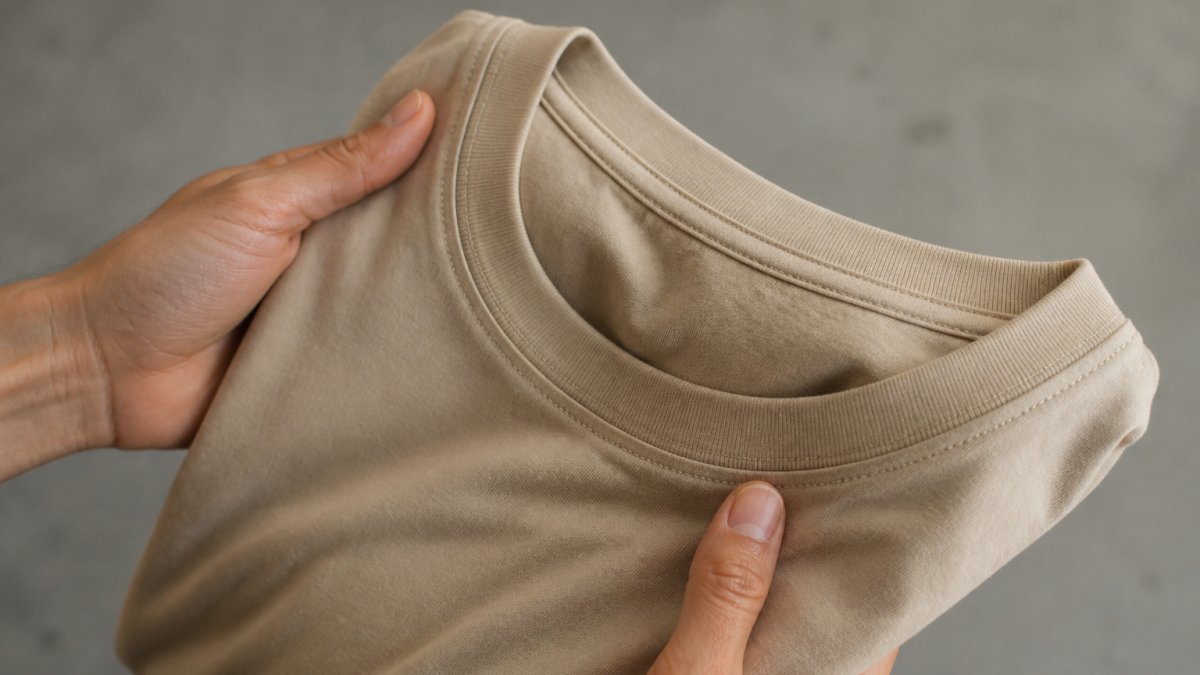
Look for side-seamed construction, which means the shirt was cut and sewn from flat fabric panels rather than a tube. Side seams hold shape better and allow a more tailored fit. Tubular shirts are cheaper to make but twist after washing.
Shoulder-to-shoulder taping reinforces the neckline and back shoulder, preventing the collar from stretching out.
Flip the shirt inside out and check the hem: uneven stitches and loose threads are the first sign of a garment that won't last.
- Side-seamed, not tubular
- Shoulder-to-shoulder taping on the neckline
- Pre-shrunk to limit shrinkage
- Tear-away or printed label
- Even, tight stitching at hems and sleeves
Run through that list before you buy. It takes thirty seconds and saves a lot of returns.
Unisex T-Shirt Fabrics in Practice: Real Shirts That Get It Right
Specs tell you how a fabric is made; fit tells you whether you'll wear it.
Our unisex tees share one core fabric spec, 100% combed and ring-spun cotton at 4.2 oz./yd.² (142 g/m²), pre-shrunk, side-seamed, shoulder-to-shoulder taped, but the designs and yarn details differ. Use the table below to compare fabric, weight, and price, then read the fit notes underneath.
| Shirt | Fabric | Weight | Price |
|---|---|---|---|
| Built by Faith Not Fear | 100% combed ring-spun cotton | 4.2 oz (142 g/m²) | $15.50 |
| Todo Lo Puedo en Cristo | 100% combed ring-spun cotton | 4.2 oz (142 g/m²) | $15.50 |
| Small But Rooted | 100% combed ring-spun cotton | 4.2 oz (142 g/m²) | $15.50 |
| Guapo & Pappi Weekend | Airlume cotton, heather blends | 4.2 oz (142 g/m²) | $24.99 |
| Team Guapo | Airlume cotton, heather blends | 4.2 oz (142 g/m²) | $24.99 |
Fit and sizing across body types. A unisex cut is a straight, relaxed silhouette with a slightly longer body and wider shoulder than a men's or women's cut. In practice:
- Straight or athletic builds: The standard unisex fit sits close to the body without pulling. If you normally wear a men's medium, a unisex medium will feel similar but slightly roomier through the waist.
- Curvier builds: The straight cut can feel boxy at the waist. Many wearers size down for a closer fit or size up and knot or tuck the hem. The side-seamed construction helps here because it allows the fabric to drape rather than twist.
- Petite frames: The longer body length may hit mid-hip. Sizing down usually shortens the body enough without tightening the chest.
- Layering: If you plan to wear the tee under a jacket or hoodie, stay true to size. If you want an oversized streetwear look, size up one, the 4.2 oz. weight drapes without looking stiff.
Use-case picks. Not every shirt needs to do everything. Here's how to choose based on how you'll wear it:
- Everyday wear and family coordination: The Built by Faith Not Fear, Todo Lo Puedo en Cristo, and Small But Rooted tees all share the same 100% combed ring-spun cotton spec, so sizing is consistent across the family. Order the same size you'd normally wear.
- Oversized streetwear look: Size up one in the Guapo & Pappi Weekend or Team Guapo tee. The Airlume cotton and 30 singles yarn give a softer hand feel that drapes well when oversized.
- Sensitive skin: Choose the solid-color 100% cotton options. Heather blends add polyester, which can feel slicker and trap more heat against the skin.
- Frequent laundering: The pre-shrunk, side-seamed construction on all five shirts resists twisting and shrinkage. Wash cold and dry low to extend the life of both fabric and print.
Environmental and labor transparency. Every shirt is made on demand with no minimums, and the fabric is sourced from Nicaragua, Mexico, Honduras, or the US.
A note on fit testing. Because unisex sizing varies by brand, measure a tee you already own, chest width, body length, sleeve length, and compare it to the product page measurements. That removes the guesswork of subjective "true to size" descriptions.
Conclusion: Choosing Fabric That Lasts Beyond the First Wash
Buying a tee online means you can't feel the fabric first, so we built our lineup around specs you can verify: combed and ring-spun cotton, 4.2 oz./yd.² weight, pre-shrunk, side-seamed, and shoulder-taped.
If you want the same softness, opacity, and shape retention we've described here, start with our Team Guapo Unisex T-Shirt or the Guapo & Pappi Weekend Adventures tee. Both use 30 singles yarn, tear-away labels, and the same mid-weight cotton that holds a print cleanly.
Choose Molina Faith and Friends for unisex tees made from soft, durable cotton with a flattering fit for every body type.
Frequently Asked Questions
What fabric is best for a high-quality unisex T-shirt?
Combed and ring-spun cotton at around 4.2 oz/yd² (142 g/m²) balances softness, breathability, and durability well. This weight feels light enough for everyday wear but holds its shape after repeated washing. Pre-shrunk fabric and side-seamed construction add to longevity. If you want a graphic tee that resists fading, 100% cotton takes screen printing cleanly, while blends work better for stretch and wrinkle resistance.
Is 100% cotton or a cotton polyester blend better for T-shirts?
100% cotton gives you breathability, a natural feel, and excellent print adhesion for graphic tees. A cotton polyester blend (like 52% cotton, 48% polyester in heather colors) adds stretch, resists wrinkles, and dries faster. For everyday wear and layering, cotton wins on comfort. For athletic use or frequent washing, a blend holds color and shape longer. The right choice depends on whether you prioritize feel or easy care.
How can I tell whether a T-shirt fabric will shrink or lose its shape?
Check for pre-shrunk fabric on the label, which means the cotton was treated to minimize shrinkage after washing. Also look for side-seamed construction, which prevents the tube-like twisting common in cheaper tees. Shoulder-to-shoulder taping reinforces the neckline so it does not stretch out. Fabric weight matters too: very lightweight fabrics (under 4 oz/yd²) tend to lose shape faster than 4.2 oz/yd² or heavier cotton.
What fabric weight should I look for in a durable T-shirt?
A fabric weight of 4.2 oz/yd² (142 g/m²) is a solid middle ground for durability and comfort. Heavier fabrics (5.5 oz/yd² and up) last longer but feel warmer. Lighter fabrics (3.5 to 4 oz/yd²) feel cooler but may wear out faster. For graphic tees, 4.2 oz/yd² provides enough surface for prints to bond without the shirt feeling stiff. Check the GSM: 140-150 GSM works well for year-round wear.