
Last Updated: October 26, 2026
Quick Summary
Both Strangeways and Cotton Bureau are indie apparel brands offering graphic tees, but they differ in blank quality, curation approach, and availability. Cotton Bureau emphasizes hand-pulled screens and heavyweight blanks for print fidelity, while Strangeways offers a broader range prioritizing wearability. Choose based on your wear frequency, fit preferences, and return policy needs rather than brand reputation alone.
- Cotton Bureau uses limited-production model with community voting; designs can sell out or return in later runs.
- Strangeways carries a broader standing catalog but specific sizes and colorways still go out of stock.
- Check blank weight in oz/yd² on product listings, not brand homepage, as indie brands rotate suppliers.
- Compare total landed cost including shipping, tax, and return costs before deciding between the two.
- Verify current pricing, policies, and recent customer feedback on brand sites before ordering.
Table of Contents
- What You Need to Know About Strangeways vs Cotton Bureau
- Apparel Styles and T-Shirt Blank Quality
- Cotton Bureau T-shirt quality and fabric composition
- Graphic tee fit and sizing across both platforms
- Print durability, design selection, and customization
- How to choose a graphic T-shirt that lasts
- Finding the best websites for graphic tees beyond these two options
- Pricing, shipping, and returns: What actually matters
- Frequently Asked Questions
What You Need to Know About Strangeways vs Cotton Bureau
When shopping for indie apparel brands, the choice between Strangeways and Cotton Bureau matters more than you'd think. Both position themselves as curated, community-driven platforms for graphic tees, but they deliver very different experiences.
The real question isn't which brand is objectively "better", it's which aligns with what you care about.
Apparel Styles and T-Shirt Blank Quality
Most Strangeways vs Cotton Bureau write-ups stay at brand vibe: one is 'curated,' the other 'versatile.' That's not enough to buy on. The useful comparison is at the garment level, what blank each platform prints on, how it's constructed, and how it wears over time.
What 'blank quality' actually means
A t-shirt blank is the undecorated garment before printing. Two shirts can look identical on screen and behave differently after washing because of several variables: Learn why soft fabrics matter for comfort in apparel and how they affect long-term wear.
How to compare Strangeways and Cotton Bureau like for like
Screenshot both product pages on the same day and save them. Indie brands change blanks and suppliers, so a review written six months ago may describe a garment that no longer exists.
Where the two platforms tend to diverge
- Cotton Bureau has historically emphasized screen-printed, design-forward apparel and has talked publicly about printing details like hand-pulled screens and custom labeling. That positioning usually pairs with midweight to heavyweight blanks chosen for print fidelity. Verify the actual oz/yd² on the listing rather than inferring it from brand copy.
- Strangeways presents a broader apparel range with an emphasis on wearability across styles. Broader ranges often mean more than one blank is in rotation, so check the specs on the specific item you're buying, not the brand's homepage.
A quick spec checklist before you buy
If a listing is missing more than two of these, email support, a brand that can't answer basic spec questions is one to approach cautiously.
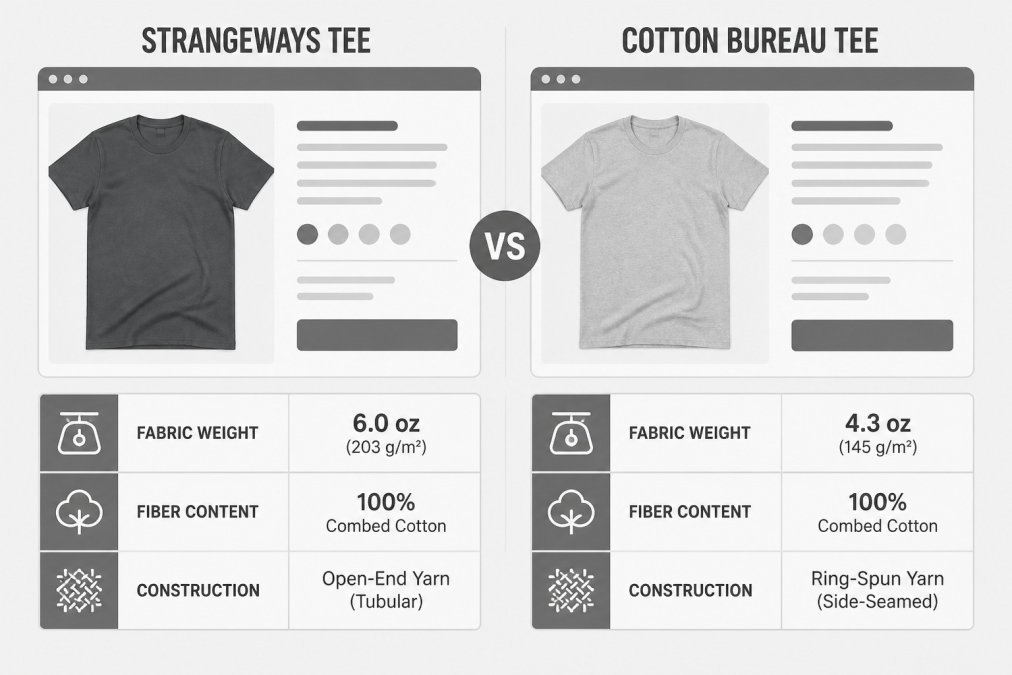
Cotton Bureau T-shirt quality and fabric composition
However, one customer review snippet from WorthEPenny's Cotton Bureau ratings described shirts as soft and comfortable but thinner than expected. This contrasts with Cotton Bureau's marketing language around heavyweight apparel. The discrepancy suggests either variation in production batches or a mismatch between marketing claims and actual garment specs.
Graphic tee fit and sizing across both platforms
- Shoulder seams should sit at your actual shoulder point, not drooping or pulling
- Sleeve length should end between your wrist and mid-forearm
- Torso length should reach your hip bone without bunching or gaping
- Chest width should allow one finger of space inside the garment when buttoned (for reference)
You can learn more about best unisex sizing tips for apparel to make confident choices across any indie brand.
Print durability, design selection, and customization
The tradeoff: hand-squeegeed prints are labor-intensive, which limits design complexity and increases production costs. Cotton Bureau's curation process reflects this, not every design makes it to production. Reddit discussions in r/printondemand mention that some uploaded designs were rejected, suggesting marketplace curation or approval limits which designs are accepted.
How to choose a graphic T-shirt that lasts
Consider your wear pattern. If you wear graphic tees 3-4 times weekly, invest in heavier blanks and proven print techniques; for occasional weekend pieces, lighter blanks are fine. Neither brand is objectively "better" here, it depends on your use case.
Finding the best websites for graphic tees beyond these two options
When evaluating any indie apparel brand, apply the same criteria we've covered here: blank quality, fit consistency, print durability, and design range. Explore how Strangeways compares to other indie brands to find alternatives that match your priorities. The best websites for graphic tees are the ones that prioritize transparency about their materials and production process. Compare Cotton Bureau with other indie shirt options to discover which brand fits your needs.
Pricing, shipping, and returns: What actually matters
Price is the easiest thing to compare and the easiest thing to compare badly. A $32 tee and a $28 tee aren't meaningfully different until you factor in shipping, taxes, return costs, and how likely you are to need a return. Here's a repeatable way to compare Strangeways and Cotton Bureau on total cost of ownership, and the policy details indie brands often bury.
Build a true landed-cost comparison
- List price of the exact garment and size you want
- Shipping cost to your address, including any handling fee
- Estimated tax or duty for cross-border orders
- Return shipping cost if the fit is wrong
- Restocking fee, if any
What to check on each brand's policy pages
- Return window, how many days from delivery, and whether it starts at ship date or delivery date
- Condition requirements, tags attached, unworn, original packaging
- Exclusions, final-sale items, limited editions, and personalized or made-to-order pieces are commonly non-returnable
- Defect handling, who pays return shipping for a misprint or faulty seam
- Exchange vs refund, some brands offer exchanges but not refunds, or vice versa
- International returns, whether the customer covers return shipping and duties
Availability and drop timing
- Cotton Bureau has historically used a community-voting and limited-production model, so popular designs can sell out or return in later runs. Check whether a design is 'in production,' 'available,' or 'retired.'
- Strangeways tends to carry a broader standing catalog, but specific sizes and colorways can still go out of stock. Check the size selector before you fall in love with a design.
A simple decision rule
- If you're buying one or two shirts and want the lowest risk, prioritize the brand with the clearer size chart and more forgiving return window, even at a slightly higher price.
- If you're buying multiple items, calculate shipping per item; flat-rate or free-shipping thresholds can swing the total cost significantly.
- If you're buying a gift, favor the brand with gift receipts and a straightforward exchange process, and order early enough to allow for a size swap.
Verify before you trust any review (including this one)
Pricing and policies change more often than fabric specs. Before ordering, confirm the current price, shipping estimate, and return terms on the brand's own site, and check recent customer feedback on independent review platforms. Treat any quoted price or policy as a snapshot, not a permanent fact.
Before comparing total cost, check these key policy details that indie brands often bury on their sites.
| Policy Detail | What to Verify |
|---|---|
| Return window | Days from delivery; starts at ship or delivery date |
| Condition requirements | Tags attached, unworn, original packaging |
| Exclusions | Final-sale, limited editions, personalized pieces |
| Defect handling | Who pays return shipping for misprint or faulty seam |
| Exchange vs refund | Whether brand offers exchanges, refunds, or both |
| International returns | Customer covers return shipping and duties |
| Availability model | Cotton Bureau uses limited production; Strangeways broader catalog |
Frequently Asked Questions
How does Cotton Bureau compare with Strangeways for graphic tees?
Cotton Bureau positions itself as a curated, crowd-funded community for designers with a focus on heavyweight apparel and hand-squeegeed screen printing. Strangeways operates similarly as an indie apparel marketplace. Both emphasize quality over mass production. Cotton Bureau holds a TrustScore of 3 out of 5 on Trustpilot based on 5 reviews, reflecting a small but mixed customer base. The key differences lie in fabric weight preferences, design curation approach, and available customization options. Your choice depends on whether you prioritize heavyweight construction or prefer lighter-weight garments.
What should you look for when comparing graphic T-shirt quality?
Examine fabric weight (measured in grams per square meter), material composition (100% cotton, cotton-poly blends, or tri-blends), and stitching details. Check the print method: screen-printed designs hold up better than direct-to-garment printing over time. Look for reinforced collar and sleeve seams. Read customer reviews specifically about shrinkage and how the shirt feels after multiple washes. Verify the brand provides a detailed size chart and compares garment dimensions, not just S/M/L labels. High-quality graphic tees maintain their shape, color, and print durability through regular wear and washing.
Are independent apparel brands worth the price compared to mass-market options?
Independent apparel brands typically cost more than big-box retailers because they use higher-quality blanks, limit production runs, and invest in better printing techniques. You're paying for durability, fit consistency, and unique designs you won't find elsewhere. Customers report that indie-brand shirts hold their shape and color longer, reducing replacement frequency. The trade-off is upfront cost versus long-term value. If you wear the same shirt regularly for years, the per-wear cost becomes competitive with cheaper alternatives that wear out faster.
What's the best way to check a T-shirt's fit before ordering online?
Always consult the brand's detailed size chart and compare your own measurements to the garment dimensions, not just your usual size. Look for customer photos and reviews that show how the shirt fits on real bodies. Check whether the brand offers unisex or fitted cuts, as this affects how it drapes. Read reviews mentioning shrinkage patterns, some shirts shrink significantly, changing the fit after the first wash. If the brand offers free returns or exchanges, order a size up and down if you're between sizes. Many indie brands accept returns within 30 days, giving you a safety window to test the fit at home.
